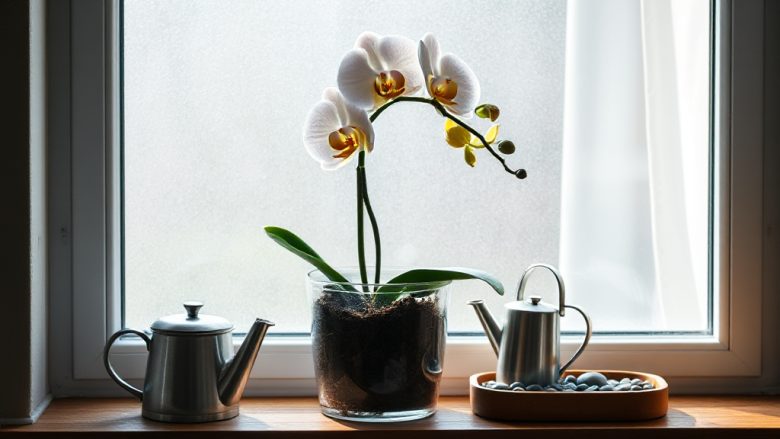
You bought a moth orchid from a supermarket. For six weeks it looked spectacular on the windowsill, then the flowers dropped one by one and the bottom leaves turned yellow. Now you’re staring at a sad green stick, wondering whether you’ve killed it or whether this is just what orchids do. It’s fixable. Almost every problem UK orchid owners run into comes down to a handful of causes, and once you know which symptom points to which cause, keeping these plants alive and getting them to flower again becomes far less mysterious. This complete guide to orchid care in the UK is organised by problem rather than by general principles, because that’s how most people actually learn.
Why Your Orchid’s Leaves Are Turning Yellow
Yellow leaves are the single most common complaint, and they can mean three very different things. The trick is working out which one you’re dealing with before you do anything drastic.
If the yellowing is confined to one or two of the oldest leaves at the very bottom of the plant, and those leaves eventually dry out and drop off, that’s normal ageing. A healthy phalaenopsis will shed a leaf every few months. Nothing to do. Resist the urge to rescue it with extra water or fertiliser, which is how a non-problem becomes a real one.
If the yellow spreads upwards and the leaves feel soft and limp rather than papery, you’re almost certainly overwatering. This is the classic UK mistake. British homes are cool and often poorly ventilated in winter, central heating dries the air but not the compost, and orchids sitting in a sealed decorative pot have nowhere for moisture to go. Roots suffocate, then rot, then the plant starts cannibalising its own leaves. Check the roots through a clear inner pot: healthy roots are firm and silvery-green, rotten ones are brown, mushy and smell sour.
If the yellowing appears as mottled patches with brown or black edges, and it’s happening in summer on a south-facing windowsill, you’ve probably got sunburn. Orchids want bright but indirect light. A sheer curtain or a spot a metre back from the glass solves it. Move the plant, don’t cut the damaged leaf unless it’s completely dead, since the green parts are still working.
Root Rot: The Most Destructive Orchid Problem
Root rot kills more indoor orchids in the UK than anything else, and it nearly always starts with good intentions. You water on a schedule, the compost stays damp, and within a few weeks the roots have turned to brown sludge. By the time the leaves yellow, the damage is well advanced.
The fix is unglamorous but effective. Take the plant out of its pot, rinse the roots under lukewarm water, and cut away anything that’s brown, hollow or mushy with clean scissors. Dust the cuts with cinnamon powder, which is a gentle natural antifungal, and repot into fresh orchid bark. Not standard houseplant compost. Orchid bark is chunky and free-draining, and it lets air reach the roots, which is what they actually need.
Then change how you water. In a UK climate, most phalaenopsis need watering roughly once a week in summer and every ten to fourteen days in winter, but the schedule should follow the plant, not the calendar. Water when the roots inside the pot have gone silvery and the bark feels dry an inch down. Water thoroughly at the sink, let it drain completely, and never let the pot sit in a saucer of water. If your orchid lives in a decorative outer pot, take it out to water and put it back only once it’s stopped dripping.
No Flowers? How to Get an Orchid to Rebloom
A supermarket orchid that flowers for months and then does nothing for a year is not broken. It’s resting. Phalaenopsis typically flower once a year, sometimes twice if they’re happy, and the gap between blooms is normal. What isn’t normal is a plant that never flowers again.
The usual culprit is light. A UK north-facing room or a spot well back from the window gives an orchid just enough light to survive but not enough to trigger flowering. Move it somewhere bright but out of direct summer sun, ideally an east or west windowsill. You should be able to read a newspaper comfortably in the light the plant receives.
The second culprit is temperature. Orchids respond to a drop of around five to eight degrees at night, which is what tells them the season has changed and it’s time to produce a spike. In a centrally heated British home, the temperature barely moves between day and night, so the plant never gets the signal. From September, move your orchid to a cooler room, ideally somewhere that drops to around 15 to 16°C at night. Keep it there for four to six weeks. This single change is often enough to produce a new flower spike.
Feed lightly during the growing season, roughly every second watering from spring to early autumn, using a diluted orchid fertiliser at half the recommended strength. Overfeeding is worse than not feeding. It produces soft leafy growth at the expense of flowers and can burn the roots.
Watering, Compost and the UK Tap Water Question
British tap water is hard in most regions, and orchids are not fond of it. The minerals, particularly calcium, build up in the bark over time and can damage roots. You don’t need to buy bottled water, but rainwater collected from a water butt is ideal, and filtered water is a reasonable compromise. If you only have tap water, flush the pot thoroughly every few months by running plenty of water through it to wash out accumulated salts.
On compost, the rules are simple. Orchid bark, never multipurpose compost. Bark breaks down over two or three years and starts holding water like a sponge, which is when root rot creeps in. Repot every two to three years, ideally in spring just as new roots start to appear. If the bark smells sour or has turned to mush, repot immediately regardless of the season.
Light, Humidity and Positioning in a British Home
UK homes are darker than most people assume, especially in winter, and orchid problems frequently trace back to a plant sitting in a dim corner because that’s where it looked nice. Orchids need more light than most houseplants but less than a cactus. An east-facing windowsill is close to perfect. A south-facing one works if you filter the summer sun. A north-facing room is a struggle for most orchids, and no amount of feeding will compensate.
Humidity matters too. Central heating drops indoor humidity to desert levels between October and March, and orchid buds often dry up and drop before opening as a result. Grouping plants together helps, as does standing pots on a tray of pebbles with water below the pebble line. A humidifier in the room is the most reliable fix, and it benefits you as well as the plants.
One more thing worth knowing: orchids hate cold draughts and they hate being moved. Pick a spot, get the light and temperature roughly right, and leave the plant alone. Fussing is a real cause of failure.
Pests, Fungus Gnats and Other Nuisances
The most common pest on UK indoor orchids is the fungus gnat, those small black flies that hover around the compost. They’re a symptom of persistently wet bark rather than a serious threat in themselves, so the fix is to let the compost dry out more between waterings and repot if the bark is breaking down. Yellow sticky traps catch the adults in the meantime.
Mealybugs look like small white cottony blobs tucked into leaf joints and under leaves. Wipe them off with a cotton bud dipped in rubbing alcohol, and repeat every few days until they stop appearing. Scale insects appear as small brown bumps on leaves and stems and can be scraped off the same way. Both are more common in winter when air circulation is poor, so improving ventilation helps prevent them.
If you spot a clear, sticky residue on leaves, that’s honeydew, and it means sap-sucking insects are present somewhere above. Follow the trail.
A Seasonal Orchid Care Calendar for UK Conditions
Orchid care in Britain is genuinely different from care in warmer, sunnier climates, mostly because of our short winter days and damp, cool summers. Here’s how the year breaks down.
Spring (March to May). Growth resumes. Increase watering slightly, start feeding every second watering, and repot if it’s due. New roots and often a new leaf appear now. Move the plant closer to the window as light levels rise.
Summer (June to August). The main growing season. Water roughly weekly, feed regularly, and watch for sun scorch if the plant is on a south-facing sill. Ventilation matters more than ever. This is also the best time to repot if you missed spring.
Autumn (September to November). The critical period for reblooming. Reduce watering, stop feeding by mid-autumn, and move the plant somewhere cooler at night to trigger a flower spike. Watch for the first signs of a spike emerging from the base of a leaf, which looks like a small green mitten.
Winter (December to February). Keep the plant cooler and water less, roughly every ten to fourteen days. Keep it away from radiators and cold windows. If a spike is developing, don’t move the plant, as buds can drop. Once flowers open, they’ll last longer in a slightly cooler spot.
Frequently Asked Questions About Orchid Care in the UK
Should I cut the flower spike after the flowers drop?
You can. Cut it back to just above the second node from the base, and the plant may produce a secondary spike from that point. Alternatively, cut the whole spike off at the base and let the plant rest and put its energy into roots and leaves. Both approaches work; cutting lower generally gives a stronger plant and better flowers next time.
Why are my orchid’s buds dropping before they open?
Bud drop is almost always environmental shock. Common causes include cold draughts, sudden temperature changes, low humidity from central heating, or the plant being moved while in bud. Once buds start forming, leave the plant where it is and keep the air around it reasonably humid.
Can I keep an orchid in a bathroom with no window?
No. The humidity would be lovely, but without natural light the plant will slowly decline and never flower. A bathroom with a decent window can work well, provided it doesn’t get too cold at night.
How do I know when to water my orchid?
Ignore the calendar and look at the roots. In a clear pot, healthy roots are silvery-grey when dry and green when wet. Water when they’ve gone silvery and the bark feels dry an inch down. In a UK home, that’s usually every seven to ten days in summer and every ten to fourteen in winter.